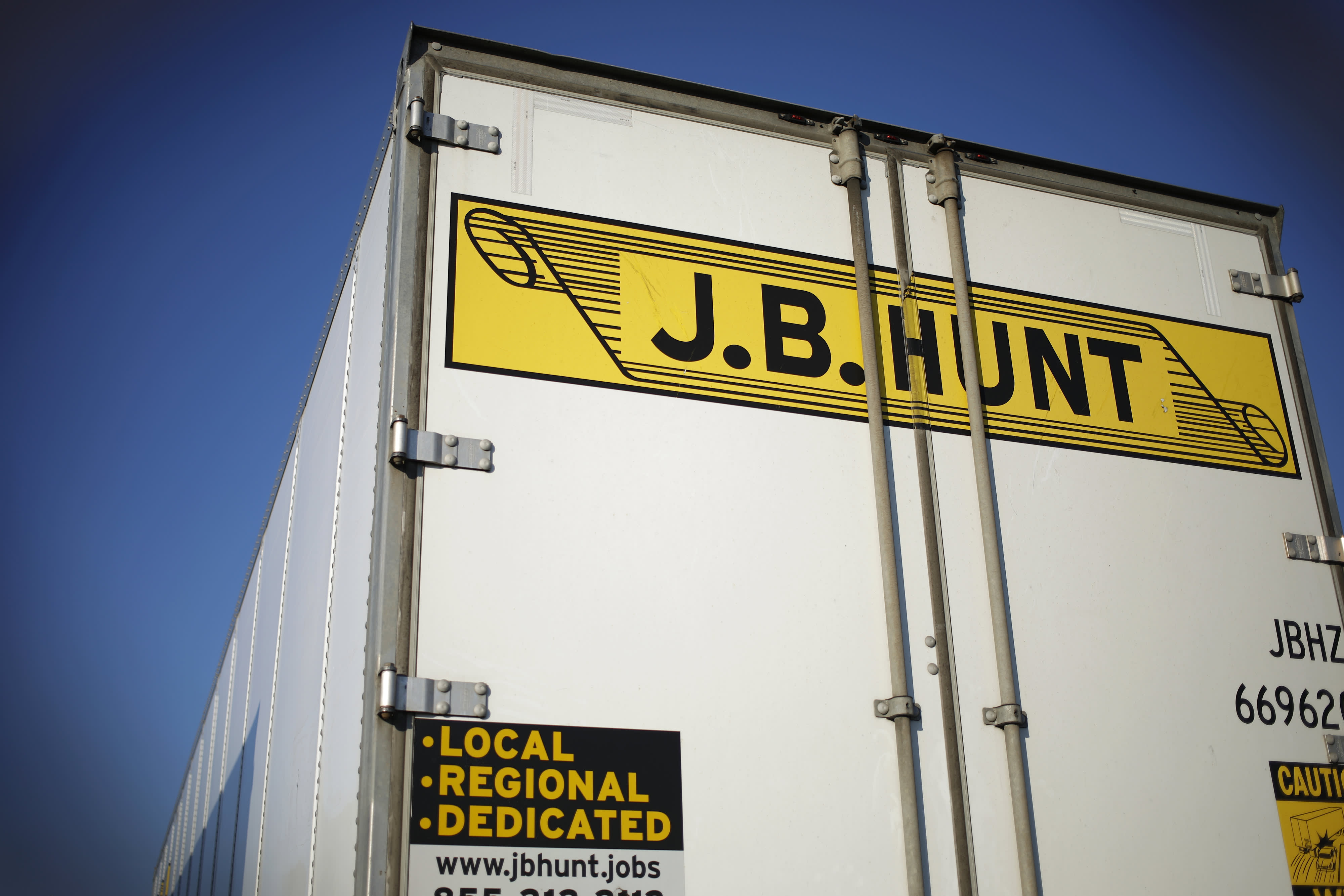
J.B. Hunt Stock Tumbles 13% as Q3 Earnings Outlook Disappoints Investors
J.B. Hunt shares plunge after trucking giant warns third-quarter earnings will decline due to rising costs and fuel prices, despite preparing for growth.
Source: CNBC
In the volatile world of transportation stocks, few moves have been as dramatic as J.B. Hunt's recent 13% plunge following the company's earnings warning. This significant drop comes at a critical time when investors are closely monitoring how logistics companies are navigating unprecedented economic challenges. The trucking industry, often seen as a bellwether for economic health, is facing mounting pressures that are reshaping investor expectations and company strategies across the sector.
Key Points
- Earnings Decline Expected: J.B. Hunt has announced that its third-quarter earnings will fall 5-10% compared to the second quarter, a direct result of increased operational costs that are impacting the company's financial performance.
- Significant Cost Increases: The company anticipates approximately $25 million in additional costs during Q3, primarily attributed to expenses related to recruiting, advertising, onboarding, training, and sign-on bonuses as J.B. Hunt prepares for future growth.
- Fuel Price Volatility: Chief Financial Officer Brad Delco highlighted that the company is experiencing "some of the most radical and abnormal swings" in fuel prices, with record-high diesel prices creating at least a $10 million headwind for the company's operations.
- Growth Strategy: Despite the current challenges, J.B. Hunt frames these increased expenses as necessary investments in preparation for growth, suggesting that the company is taking a long-term view rather than focusing solely on quarterly results.
- Sequential Volume Improvements Expected: Management anticipates that volume improvements will help offset the incremental pressures, though they acknowledge that margin repair remains a work in progress with "a long way to go."
- Market Context: This news comes particularly striking as J.B. Hunt stock has risen nearly 100% over the past year, making the recent decline more pronounced in the context of the company's recent strong performance.
In-depth Analysis
The situation at J.B. Hunt reflects broader challenges facing the transportation and logistics industry in an increasingly complex economic environment. The company's admission of "radical and abnormal swings" in fuel prices underscores the unprecedented volatility in energy markets that is affecting supply chains worldwide. This volatility, combined with persistent labor shortages and rising operational costs, is creating a perfect storm that is testing the resilience of even the most established players in the sector.
From a strategic perspective, J.B. Hunt's approach to these challenges reveals a calculated risk-reward balance. The company's willingness to invest heavily in recruitment and training suggests confidence in future growth opportunities, even as it acknowledges near-term margin pressures. This forward-looking strategy may position J.B. Hunt favorably when the market eventually stabilizes, though investors are clearly concerned about the timing and magnitude of these investments.
The market's reaction—sending shares down 13%—indicates that investors had priced in more optimistic expectations for Q3 results. This creates an interesting dynamic for the coming quarters, as J.B. Hunt will need to demonstrate that its investments are translating into sustainable growth rather than just increased costs. The trucking industry's sensitivity to economic cycles means that J.B. Hunt's performance could serve as an early indicator of broader economic trends in the coming months.
Looking ahead, the company's ability to navigate these challenges will likely depend on several factors: the trajectory of fuel prices, the effectiveness of its recruitment and retention strategies, and the overall demand for transportation services. As the industry continues to evolve, J.B. Hunt's response to these current headwinds may set a precedent for how other logistics companies approach similar challenges in an increasingly uncertain economic landscape.
Frequently Asked Questions
What caused J.B. Hunt's stock to drop so significantly? The stock decline was primarily driven by the company's announcement that third-quarter earnings would fall 5-10% due to increased operational costs, including $25 million in additional expenses related to recruitment and training, combined with $10 million in headwinds from record-high diesel prices.
How does this compare to J.B. Hunt's recent performance? This news comes after J.B. Hunt stock has risen nearly 100% over the past year, making the 13% drop particularly notable as it represents a significant reversal from the company's recent strong performance and investor expectations.
What is J.B. Hunt doing to address these challenges? The company is investing heavily in recruitment, advertising, onboarding, training, and sign-on bonuses to prepare for future growth, while also working to repair margins and expecting sequential volume improvements to help offset the current cost pressures.
Source: https://www.cnbc.com/2026/09/16/jb-hunt-stock-jbht-earnings.html
Related posts

JMTG Optoelectronics' Upstream Network: The Hidden Interconnections Between Executives and Suppliers
An in-depth analysis of how JMTG Optoelectronics executives and their funds have invested in upstream suppliers, raising questions about transparency and disclosure standards.

Premium Seating: How 30% of Airline Seats Drive Half of Revenue
American Airlines reveals that just 30% of its seats generate half of total revenue, driving industry-wide shift toward premium cabin configurations.

Rising Living Costs: How Americans Are Coping With Inflation
Exploring how persistent inflation and rising prices are reshaping American households' financial decisions and daily lives ahead of the midterms.
CATL Loses 210 Billion: Who is Hunting the Battery Giant?
CATL's market cap evaporated by 210 billion in a month. Explore the reasons behind the crash, from EV giants going independent to new tax policies.
Bank of America Q3 Investment Banking Fees Drop Over 10%, Wall Street AI Boom Faces Headwinds
Bank of America CEO Brian Moynihan reports a double-digit decline in investment banking fees for Q3, signaling a cooling period for the AI-fueled capital markets surge.

China's New '15th Five-Year Plan' for Electronics Manufacturing: A Global Tech Powerhouse Strategy
China unveils ambitious roadmap for electronics manufacturing growth, targeting $30 trillion revenue by 2030 with focus on AI, semiconductors, and green technology.

2027 Ford F-150: V8 Engines Return, Performance Prices Cut
Ford expands V8 availability across all F-150 models and lowers starting prices for 2027 trims, including the Raptor and Tremor, to boost affordability.

China's Property Market Recovery: First-Tier Cities See Housing Price Growth in August
China's top-tier cities saw a significant rebound in housing prices in August, signaling a potential stabilization in the property market.
Latest Articles
- Huawei-Serres Partnership Enters New Era: Shift to Light Asset Model
- Trump Calls AI Risks a 'Scam,' Backs Nvidia CEO Jensen Huang
- GM's Strategic Pivot: Domestic Battery Development to Counter China Ties
- The Rise of Main Street Millionaires: Hidden Wealth in Plain Sight
- Urban Hukou Reform: Unlocking 1-2 Trillion in New Consumption